
We tend to talk about star formation as if gravity does the whole job. Cold gas collapses, density rises, fusion switches on, done. Clean story, neat diagram, everybody goes home happy.
But the real version is messier, and honestly, more interesting. A new study of the DR21 star-forming region suggests magnetic fields are not just background decoration in these clouds. They appear to guide gas through smaller filaments and into a dense central ridge where stars are forming rapidly.
That matters because one of the oldest headaches in astrophysics is figuring out how gas actually moves through molecular clouds, and why only a small fraction of that gas ever ends up in stars at all. In DR21, we may be seeing part of that answer in action.
What the new study looked at
The research focuses on DR21, a molecular cloud about 6,000 light years away. It is a busy star-forming environment, roughly 80 light years across, and it contains some of the most massive stars known in the Milky Way.
At the center of this work is DR21’s “main ridge,” a dense, massive filament inside the cloud. This ridge is thought to be gravitationally unstable, and it is fed by smaller surrounding filaments. If we want to understand how massive stars form, regions like this are exactly where we’d expect the key physics to show itself.
The study was published in The Astrophysical Journal under the title SIMPLIFI – Study of Interstellar Magnetic Polarization: A Legacy Investigation of Filaments. I. Magnetically Guided Accretion onto the DR21 Ridge. Lead author Thushara Pillai is a research scientist at MIT Haystack Observatory.
Why magnetic fields matter here
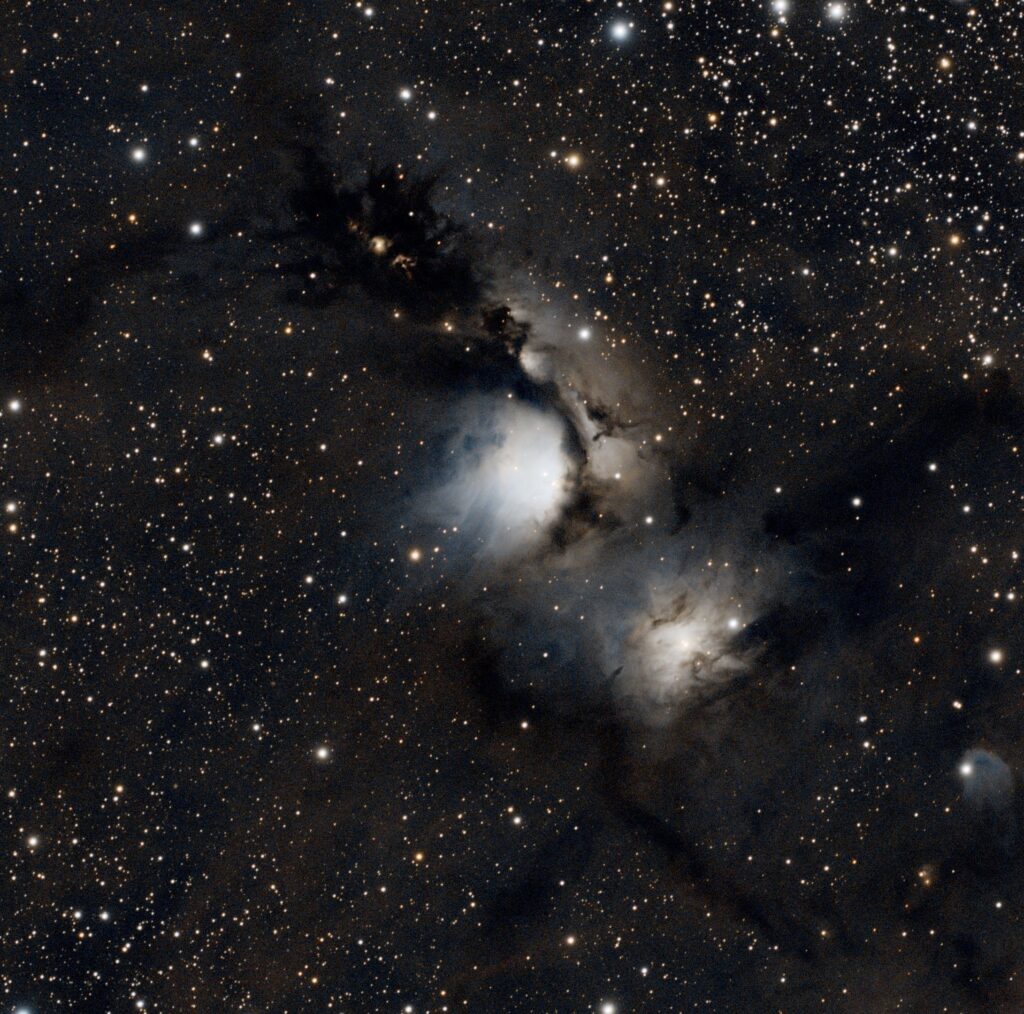
Here’s the big idea. Gas in a molecular cloud does not move equally in every direction. Magnetic fields introduce a preferred direction, because the Lorentz force resists motion across field lines more than motion along them.
In plain terms, gas can move more freely along those lines than across them. That means magnetic fields can shape the traffic flow inside a cloud, even when gravity, turbulence, radiation, and chemistry are all in the mix.
The authors argue that this is exactly what appears to be happening in DR21. The smaller subfilaments seem to channel material along magnetic field lines into the main ridge, steadily building it up and helping sustain the conditions needed for high-mass star formation.
We’ve seen hints of this kind of behavior before in lower-mass star-forming clouds. What makes this result interesting is that DR21 is a much more extreme environment, and the same basic pattern still appears to hold.
How astronomers traced the field
Magnetic fields in these clouds are not observed directly in the way we might trace a visible structure in an image. Instead, astronomers use polarimetry, which measures the polarized emission from warm dust grains. Those grains tend to align with the local magnetic field, giving researchers a way to infer the field’s orientation.
This work draws on SIMPLIFI data using SOFIA and its HAWC instrument. SOFIA, the Stratospheric Observatory for Infrared Astronomy, has since ended operations, but its data are still producing useful science. NASA’s mission overview for SOFIA and the German Aerospace Center’s description of the HAWC instrument give the basic context for how these observations were made.
The team mapped the magnetic field across the DR21 main ridge and its surrounding filaments. The key advance is that the map extends beyond only the highest-column-density regions, giving a broader view of how the field behaves across the larger star-forming complex.
That broader mapping matters. If we only look at the densest spots, we can miss the larger inflow pattern that feeds them.
What the team found in DR21
The core result is a persistent alignment between magnetic field orientation and gravitational acceleration, even as local conditions and gas column density change. That consistency supports the idea of magnetically guided accretion.
In the main ridge, the field lines are oriented perpendicular to the ridge itself. In the secondary filaments, the field tends to align with the filament structure. Put those two pieces together and the geometry starts to look pretty suggestive: gas is moving along smaller structures, then feeding a denser central spine.
The paper estimates that subfilaments are channeling material into the ridge at rates of several 10-3 solar masses per year. That is enough, the authors write, to assemble the ridge within about 106 years and to sustain high-mass star formation there.
If that number sounds modest, remember what scale we’re talking about. This is not one forming star sipping from a straw. It is a whole dense ridge being supplied over time. In that context, a few thousandths of a solar mass per year is substantial.
A quick breakdown of the physical picture
We can think of the study’s proposed flow pattern like this:
- Large molecular cloud contains multiple filamentary structures.
- Subfilaments guide gas along magnetic field lines.
- That gas feeds the main dense ridge.
- The ridge then hosts dense star-forming cores where massive stars can emerge.
The authors also conclude that the subfilaments probably did not form many, if any, stars before the gas moved through them into the ridge. In other words, these smaller structures may function more like supply lines than like independent star nurseries.
Why star formation is so inefficient
This is the part of the story we should not skip. Star formation sounds prolific because the universe has a lot of stars, but inside any given molecular cloud the process is surprisingly inefficient. Only a few percent of the gas typically turns into stars.
That tells us something is slowing collapse, redirecting matter, or otherwise preventing gravity from turning the whole cloud into a stellar assembly line. Usually the suspects are turbulence, stellar feedback, radiation, chemistry, and magnetic fields. The hard part is figuring out who is doing what, on which scale, and when.
DR21 does not solve that entire puzzle, but it strengthens the case that magnetic fields are not a minor side effect. In at least some clouds, they seem to help organize the gas before gravity finishes the job.
What makes this result useful beyond one cloud
Astronomy is full of one-off environments that are fascinating but hard to generalize from. What makes DR21 more useful is that its behavior appears consistent with trends seen in lower-mass star-forming regions too.
That suggests magnetic fields may play a similar structural role across a fairly wide range of environments. Not identical in every detail, of course. Molecular clouds are chaotic beasts, and we should be careful not to flatten them into one template. Still, seeing related behavior across different regimes is exactly how a niche result starts becoming a broader physical picture.
For readers who want background on why filamentary structure matters in star-forming clouds, ESA’s overview of Herschel observations and NASA’s archival material on the Spitzer Space Telescope are helpful starting points. Both missions helped establish just how central filaments are to the star formation story.
What comes next
This paper is the first result from the SIMPLIFI program, not the last word. Future work is expected to examine magnetic field strength more directly, push the polarization analysis further, and test how broadly this picture applies.
There is also a bigger observational problem hanging over all of this. To trace magnetic fields across fainter emission and wider areas, astronomers need better far-infrared polarization capability. Right now, there is no active space-based far-infrared mission built for that job.
That may sound like inside-baseball telescope politics, but it shapes what we can know. If magnetic fields are a major part of the star formation engine, then the ability to map them well is not a luxury. It is basic infrastructure for the question.
The takeaway
We’ve known for a long time that star formation is more than gas falling inward under gravity. What this new DR21 result gives us is a cleaner look at the plumbing. The gas does not just drift into place. It appears to be funneled, organized, and constrained by magnetic structure on the way in.
That does not make gravity less important. It just means gravity may be working on a playing field that magnetic fields helped lay out first. And for those of us who like our cosmic stories with a little more than the simplified classroom version, that’s a pretty good upgrade.