
Travel gear has a bad habit of promising a smoother trip while quietly becoming another thing we need to charge, pack, and inevitably lose under a hotel bed. The wearable category has a better shot than most because the useful stuff stays on us, rather than fighting for the last inch of carry-on space.
For this list, we’re looking at devices with a clear job: help us sleep through cabin noise, get around without living in our phones, monitor a disrupted routine, manage sun exposure, or cope with serious heat. Some are sensible purchases for frequent travelers. Others are expensive niche tools, and we should be honest about that before handing over a card.
Soundcore Sleep A30 for long-haul rest
Anyone who has tried to sleep on a plane knows the problem is rarely just the seat. Engine rumble, cabin announcements, neighbors shifting around, and the occasional tiny passenger staging a full-scale protest all add up. A dedicated pair of sleep earbuds can make more sense than standard wireless buds because comfort matters as much as sound.
Soundcore released its third-generation Sleep A30 earbuds in 2025. The compact buds are designed to sit flush in the ear, which is particularly relevant for side sleepers pressing an ear into a travel pillow or headrest. They also include active noise cancellation, a notable feature for sleep-focused earbuds, and Soundcore claims up to nine hours of battery life in Local Mode using on-device audio.
The companion app adds sleep-oriented sound and tracking options, so this is aimed at people who want more than a simple pair of earplugs. At $199.99, the A30 is still a premium travel accessory. We’d frame it as a comfort purchase for travelers who regularly take overnight flights, trains, or noisy shared accommodations, not an automatic buy for a couple of weekend trips a year. If we’re planning red-eyes around packed summer itineraries or even side trips built around things like rocket launch travel in the US, a wearable that can realistically cover a full overnight stretch has a clearer case.

Soundcore Sleep A30 Special by Anker, Noise Reduction Sleep Earbuds | Noise Reduction, Adaptive Snore Masking, Ultra Comfort for Side Sleepers, Vast Sleep Audio, 8-10H Playtime, Sleep Headphones
Meta Ray-Ban Display glasses for navigation and translation
Smart glasses are one of those categories where we should keep expectations grounded. They do not replace a phone, and a glasses-mounted camera will not match a high-end smartphone camera. But travel is one of the clearest arguments for putting useful information closer to our eyes while keeping our hands free.
The Meta Ray-Ban Display glasses use an in-lens display to show turn-by-turn directions and map information. That could reduce the familiar routine of stopping at every corner, checking a phone, walking ten steps, and checking it again. For destinations where we do not speak the local language, the glasses can also provide real-time spoken-conversation translation through their speakers and visual translations through the display. Text on signs and menus can be translated through Meta AI as well.
They can identify objects in view when asked, which may be useful for landmarks, plants, and other unfamiliar sights, and the built-in camera can record quick photos and videos. The $799 price places these firmly in early-adopter territory. We would not buy them solely for a single holiday, but frequent travelers who already want hands-free AI features may find that navigation and translation are the parts that justify them. If we already lean on mobile payment passes, boarding documents, and saved trip info, that same hands-free setup fits neatly beside tools like Google Wallet travel data and mobile autofill features.

Ray-Ban Meta (Gen 2) Wayfarer, Matte Black, Clear lenses | Gen 2 Wayfarer, Matte Black, Clear
Fitbit Air for tracking without the screen noise
Travel tends to scramble our normal rhythm. Workouts move around, meals get weird, sleep can be choppy, and a watch buzzing with every notification does not necessarily improve the experience. Fitbit Air takes a quieter approach by putting its sensor beneath a low-profile band and leaving off a display entirely.
Google’s Fitbit Air costs $99.99 and is rated for up to a week on a charge. That battery claim is meaningful for travel because it can remove one more cable from our nightly charging pile. The device tracks activity, sleep, and basic health metrics through its companion app, while its understated design is meant to work as an all-day and overnight band.
The standard free experience includes activity tracking, sleep tracking, basic health metrics, and health logging. Google Health Premium adds deeper insights and personalized fitness guidance for $99 annually or $9.99 monthly. Google has also made custom bands available to 3D print, which is an unusual option for anyone who wants a different fit or look.
For us, the appeal is straightforward: Fitbit Air may suit travelers who still want personal data but would rather leave smartwatch alerts behind for a few days. Just remember that the screen-free design means every result lives in the app, so it is a deliberate tradeoff rather than a missing feature.

Google Fitbit Air - Screenless Activity Tracker, Fog | Fitness, heart rate, & sleep tracking, personalized AI-powered coaching, up to 7 days’ battery life, works with iOS & Android
The90 Gem adds UV exposure tracking to a necklace-like wearable
Sunscreen remains a practical part of spending time outdoors, but it does not tell us how much ultraviolet exposure we are accumulating throughout a day at the beach, on a trail, or walking through an unfamiliar city. The90 Gem is built around that gap.
Launched in June 2026 at $299, The90 Gem is a necklace-like device that tracks both UVA and UVB exposure. Its app creates a skin profile through a short set of questions, then factors in sunscreen use and clothing when assessing exposure. The device can send sunscreen reapplication reminders and provide personalized guidance on limiting UV exposure.
The distinction between UVA and UVB is useful here. UVA makes up roughly 95 percent of the UV radiation that reaches Earth’s surface and is more closely linked with deeper skin penetration and photoaging, while UVB is the smaller share but the main driver of sunburn. Both contribute to skin cancer risk. A wearable cannot replace sunscreen, protective clothing, shade, or medical advice, but exposure tracking may help people build more awareness into a day outside.
The90 Gem is currently aimed at women, with designs for men and children planned. This is a costly and specialized device, so we’d reserve it for travelers who spend substantial time in strong sun and genuinely value the data. Most of us can make a bigger difference with basic sun protection habits, but the Gem has a more focused purpose than a generic wellness gadget.
No products found.
Coolify Cyber Fold for genuinely hot destinations
There is a point where a small handheld fan stops feeling helpful and starts feeling like it is politely moving hot air around our face. Torras’ Coolify Cyber Fold is designed for the other side of that line, using thermoelectric cooling plates and multiple fans in a wearable neck device.
Released in 2026, the Cyber Fold weighs 1.17 pounds and directs cool air around the neck, face, and upper body. That is a fairly substantial accessory to wear, and the weight is worth considering before we call it an easy everyday travel companion. Still, it targets an understandable problem for people visiting very hot locations or spending long stretches outdoors.
Battery life depends heavily on the setting. In fan-only mode, it can run for up to 15.5 hours. With the cooling plates operating continuously at maximum settings, the estimate falls to around two hours. It can continue operating while connected to a power bank, which makes extended outings more realistic if we are willing to carry extra power.
The Cyber Fold can also provide warmth in colder conditions, making it more flexible than a basic fan. At $279, however, this is another purchase that needs a real use case. If we are occasionally uncomfortable on a summer city break, a lighter fan and sensible breaks indoors are probably enough. If heat regularly turns a trip into a miserable endurance event, especially during long outdoor waits for events like major rocket launches, the more powerful approach may be easier to defend.
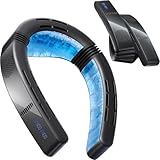
TORRAS COOLiFY 2026 Cyber Fold AI Neck Air Conditioner, Max Cooling Area | Neck & Face Cooler with Adjustable Strong Wind, Rechargeable Neck Fan for Travel Gift for Dad, Husband, Black
How we would choose among them
These devices address different travel problems, so there is no single winner. The right choice depends on what repeatedly drags down our trips.
- Choose sleep earbuds if aircraft, trains, or shared rooms regularly wreck our rest.
- Consider smart glasses if navigation and language barriers are a frequent concern and the high price fits our budget.
- Pick a screen-free fitness band if we want sleep and activity data without another notification machine on our wrist.
- Look at UV tracking if outdoor time and sun-exposure management are an ongoing priority.
- Consider wearable cooling if intense heat is a recurring, trip-altering problem rather than a minor inconvenience.
We have all bought travel gear that sounded brilliant at checkout and never made it past the first packing cube. The better bet is choosing the wearable that solves a problem we already know we have. That is how a gadget earns a spot in our bag, and ideally stays out of the drawer when we get home.