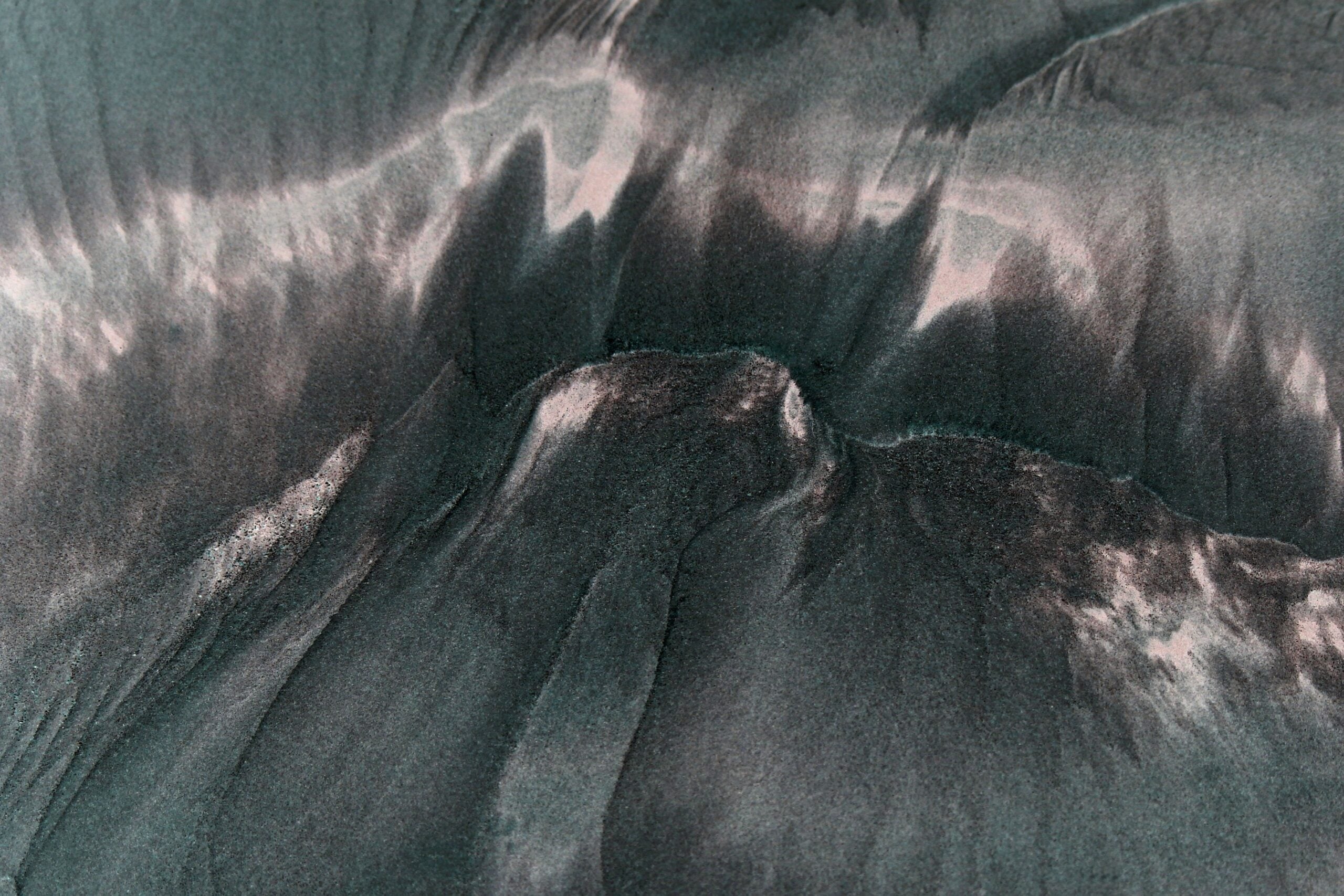
At first glance, the floor of Kaiser Crater looks less like a desert than a sheet of hammered metal. Silvery waves appear to roll through the ancient Martian basin, catching the light in a way that feels almost industrial.
The view from the European Space Agency’s Mars Express spacecraft has a simpler explanation, and a more compelling one. The bright sheen comes from seasonal frost resting against dark volcanic sand, turning an old crater into a record of wind, cold and water on Mars.
That combination is why images like this matter. A striking picture can pull people toward Mars, but its details give planetary scientists a way to read the forces that have shaped the planet for billions of years. The Mars Express view was captured by the High Resolution Stereo Camera, which can resolve surface details at scales measured in metres rather than simply offering a distant postcard.
A crater older than the dunes inside it
Kaiser Crater is a roughly 180-kilometer-wide impact basin in Noachis Terra, part of Mars’ southern highlands. Its interior drops a couple of kilometers below the surrounding terrain. The region is densely scarred by ancient impacts and is associated with the Noachian period, an early chapter in Martian history named for this heavily cratered terrain.
Mars has held onto this history unusually well. The planet lacks the active plate tectonics that continually recycles much of Earth’s surface, and its thin atmosphere offers relatively little erosion compared with our own. An impact crater can remain visible for extraordinary stretches of time, even as wind, dust, ice and seasonal weather revise the details within it.
Kaiser Crater is a good example of that layered timescale. The impact basin itself is ancient. Its dune field is a much more active feature, shaped by winds that continue to move sediment across the crater floor. The crater is named for Dutch astronomer Frederik Kaiser, a small human thread attached to a landscape no person has yet seen from the ground.
The shine is frost meeting volcanic sand
The waves in the image are dunes, some rising more than 100 meters high and extending for several kilometers. Their dark color comes from volcanic material, including minerals such as pyroxene and olivine. Against the familiar rusty tones of Mars, that dark sand already creates a dramatic contrast.
The image was taken during the latter half of the Martian southern winter, when seasonal frost can extend northward from the south polar region into mid-latitudes. Bright hoarfrost clings to the south-facing sides of dunes in Kaiser Crater. The pale coating beside the nearly black sand is what creates the metallic effect. At these temperatures, frost can persist in sheltered places even after sunlight reaches other parts of the dune field.
It is an optical trick born from ordinary planetary processes. There is no liquid metal pooling in the crater, and no evidence here of an artificial structure. The scene is colder and quieter: wind-built ridges, volcanic grains and a temporary skin of frost reflecting sunlight.
Dunes make the invisible wind visible
Sand dunes are among the clearest ways to see an atmosphere at work. Mars’ atmosphere is thin, with surface pressure less than 1 percent of Earth’s average sea-level pressure, but it is still capable of lifting and rearranging particles over time. The shapes in Kaiser Crater preserve a map of those local air currents.
Along the margins of the dune field are isolated crescent-shaped forms known as barchan dunes. Their tapered horns point downwind, a useful clue to the direction sediment has been pushed. Barchans occur in terrestrial deserts too, a reminder that similar physical rules can produce familiar shapes on very different worlds.
Nearer the middle of the field, some of those crescent forms merge into longer parallel ridges. These are transverse dunes, arranged perpendicular to the prevailing wind. Their orientation indicates winds moving from the west across this part of the crater.
- Barchan dunes are crescent-shaped and can reveal wind direction through their downwind-pointing horns.
- Transverse dunes form long ridges across the wind and point to a sustained pattern of moving air and sediment.
- Seasonal frost highlights parts of the dune field that might otherwise blend into the dark terrain.
For researchers, those patterns are more than visual texture. Dunes provide evidence of the atmospheric conditions that move material on Mars today, while also offering a baseline for tracking how landscapes shift across seasons and longer periods. Repeat images can help separate a dune that only looks active from one that has genuinely migrated or changed shape.
Lighter streaks point toward an older, wetter Mars
The dune field is only part of the story. In nearby areas, winds have stripped away darker surface material and exposed lighter deposits below. Those pale strips are thought to contain clay minerals, materials that typically form in the presence of water.
That does not mean Kaiser Crater contains flowing water now. The significance lies in what the minerals may preserve from an earlier Martian environment. Clay-bearing deposits are part of the evidence scientists use to reconstruct periods when water interacted with the surface and subsurface of Mars. On a planet where present-day liquid water is unstable at the surface, these mineral traces offer a rare record of conditions that were once more hospitable.
The crater walls add another unresolved detail. Narrow gullies cut down some of the steep interior slopes. Dry landslides may explain some of them, but past melting ice is also a possible explanation for others. The available image alone cannot settle that question, which is precisely why these features remain scientifically interesting. They invite closer study rather than a simple conclusion.
An orbiter still doing patient work after two decades
The imagery came from the High Resolution Stereo Camera aboard Mars Express, which has been orbiting Mars since 2003. Developed through a collaboration involving the German Aerospace Center, known as DLR, and Freie Universität Berlin, the camera has helped build detailed views of the planet’s terrain over a mission that has lasted more than two decades.
There is a tendency to treat long-running spacecraft as background infrastructure, especially beside the excitement of new launches. Yet missions such as Mars Express show the value of endurance. Repeat observations let scientists compare seasons, identify changes and return to landscapes that become more revealing as methods improve and new questions emerge.
Kaiser Crater also captures a useful tension in how people imagine Mars. It is often reduced to a red, dry and static world. This image offers a more complicated portrait: black volcanic dunes moving under western winds, winter frost brightening their slopes, clay minerals hinting at ancient water, and gullies whose full history is still uncertain.
The metallic appearance may be what catches the eye. The deeper story is a planet that still rewards close looking, one dune ridge and frost-brightened slope at a time.