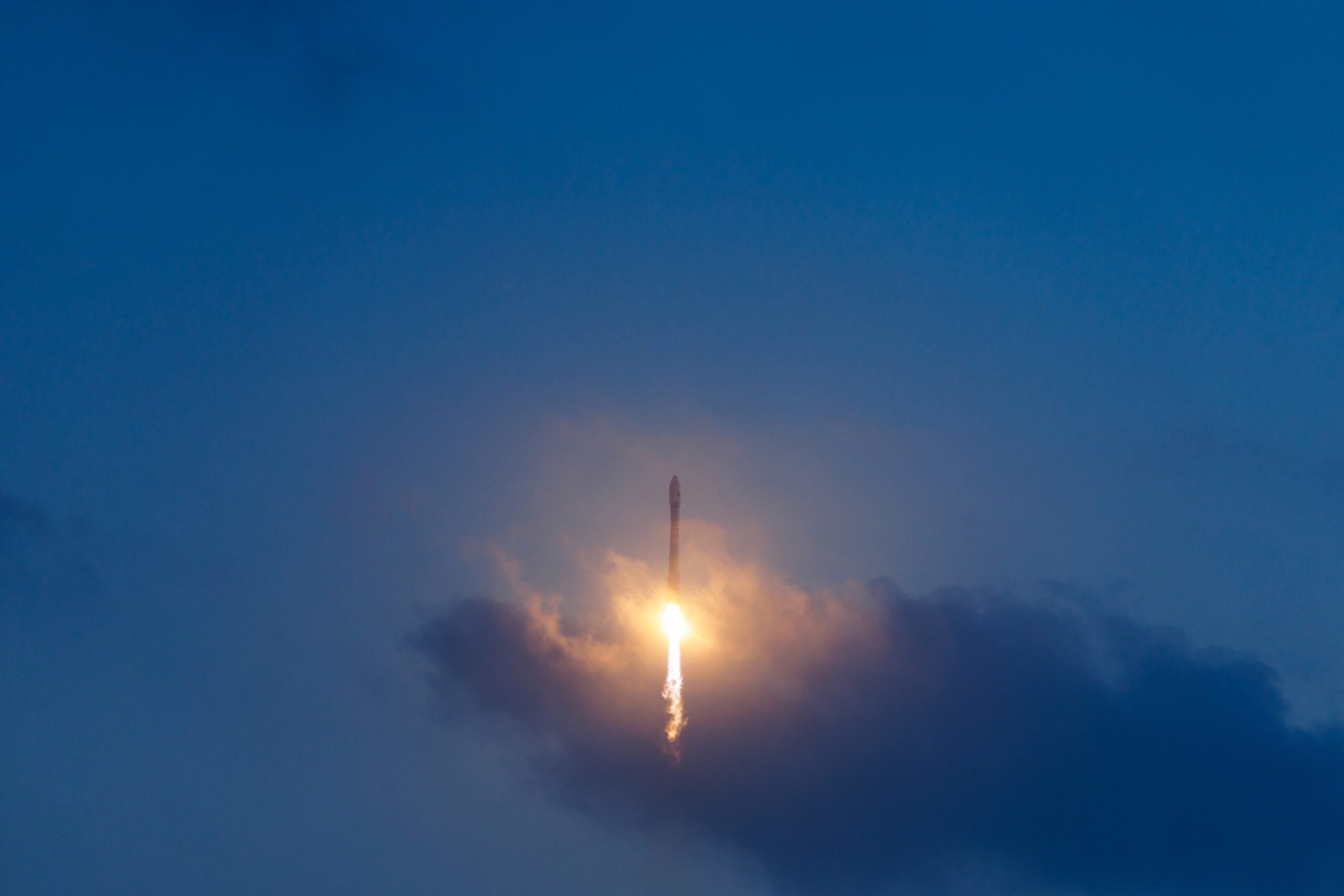
China’s launch tempo has been moving fast enough that we can barely keep up with the scoreboard, and for three days that pace stayed loud and busy. Then the Kuaizhou-11 launch went quiet, which in spaceflight reporting is usually the part where we all start checking trackers and refreshing the same tabs again and again.
According to SpaceNews, the solid rocket lifted off from Jiuquan Satellite Launch Center in the Gobi Desert at around 11:40 p.m. local time on Wednesday. Hours passed without an official update from Chinese authorities, and that kind of silence often points to trouble, whether that means a launch failure or a problem with one of the payloads.
SpaceNews later updated its report to note that the U.S. Space Force tracked the Kuaizhou-11 rocket body in orbit, which suggests the vehicle reached space. Even so, there was still no official word from Chinese authorities at the time of reporting, and no public data yet on the payloads.
What happened across the three-day stretch
The Kuaizhou-11 flight was only one part of a very busy run. China had four launches in three days, starting with a CAS Space Kinetica-1 mission on June 14 Eastern, followed by a Long March 3B launch on June 16 and then two launches on June 17 Eastern, including the Long March 12 and the Kuaizhou-11.
That matters because this was not a random burst of activity. The launches were spread across multiple vehicles and sites, and they touched a few of China’s most important launch and satellite programs, from commercial small launchers to broadband constellation deployment.
| Mission | Rocket | Launch site | What SpaceNews reported |
|---|---|---|---|
| June 14 Eastern | Kinetica-1, also known as Lijian-1 | Dongfeng Commercial Aerospace Innovation Test Zone at Jiuquan | Inserted eight satellites for Changguang Satellite |
| June 16 | Long March 3B | Xichang Satellite Launch Center | Carried Shijian-31 |
| June 17 Eastern | Long March 12 | Hainan Commercial Space Launch Site | Delivered the 22nd group of Guowang satellites |
| June 17 Eastern | Kuaizhou-11 | Jiuquan Satellite Launch Center | No official confirmation for hours, later tracked in orbit by U.S. Space Force |
Kuaizhou-11… the silence that stood out
Editorial credit: myboys.me / Shutterstock.com
If we’ve learned anything from watching launch coverage long enough, it’s that silence is a story all by itself. SpaceNews noted that the lack of Chinese confirmation after Kuaizhou-11 liftoff was unusual enough to suggest a possible failure, or at least a problem worth watching.
That concern was sharpened by the rocket’s own history. Kuaizhou-11 is a larger version of Expace’s Kuaizhou-1A. Its first flight in July 2020 failed, while three later launches succeeded, most recently a rideshare mission in March this year. So if this one had gone wrong, it would not have been a catastrophic blow to China’s broader launch program, but it would still have mattered for Expace and for anyone tracking China’s commercial launch sector.
The Long March 12 keeps feeding Guowang
While Kuaizhou-11 drew the suspense, the Long March 12 launch was the cleaner, more straightforward part of the day. CASC confirmed success and said the payloads were the 22nd group of Guowang low-Earth orbit satellites, which ties directly to China’s national broadband constellation plan.
SpaceNews said four earlier Long March 12 launches had each carried nine Guowang satellites, and based on that pattern there are now 177 Guowang satellites in orbit for the larger 13,000-satellite program. That is the kind of rollout that tells us China’s satellite internet ambitions are no longer just a paper plan. The launch vehicle itself has now flown six times since its debut in November 2024, using a horizontal assembly, test, and transport process, and it is rated for at least 12,000 kilograms to low Earth orbit and 6,000 kilograms to a 700-kilometer sun-synchronous orbit.
Shijian-31 and the return of the Long March 3B
The June 16 Long March 3B mission also deserves a closer look, even if it ended up somewhat overshadowed by the later launches. CASC identified the payload as Shijian-31 and said it would be mainly used for space environment exploration, which is about as much detail as we usually get with that series.
SpaceNews added that Shijian-31 was tracked in a Molniya orbit. It also pointed out that this flight marked a return to flight for the Long March 3B after a January 16 failure caused by a third stage anomaly. That earlier problem had knock-on effects for the Long March 7A as well, since the newer rocket inherited the 3B’s hydrolox third stage.
Launch Count:
By SpaceNews’ tally, China has attempted 43 launches so far in 2026, including three failures, with the Kuaizhou-11 status still uncertain at the time of the report. The country has also logged nine launches in June alone, which is a brisk pace by any standard.
There’s a bigger target sitting behind all of this too. SpaceNews said China is understood to be aiming to pass 100 launches in a calendar year for the first time in 2026, while also working toward new reusable rockets with much higher payload capacity than most of the current fleet.
That gives the Kuaizhou-11 silence more context. On its own, one launch matters. In the middle of a year like this, it matters a little differently. China’s launch cadence is strong enough that a single anomaly may not change the overall direction, but it still shows us where the edges of the system are, and where the next public explanation, if one comes, will be worth reading closely.
For now, that is the part we’re left with: a busy three-day stretch, a confirmed string of successes elsewhere, and one mission that had everyone waiting for the official word.