
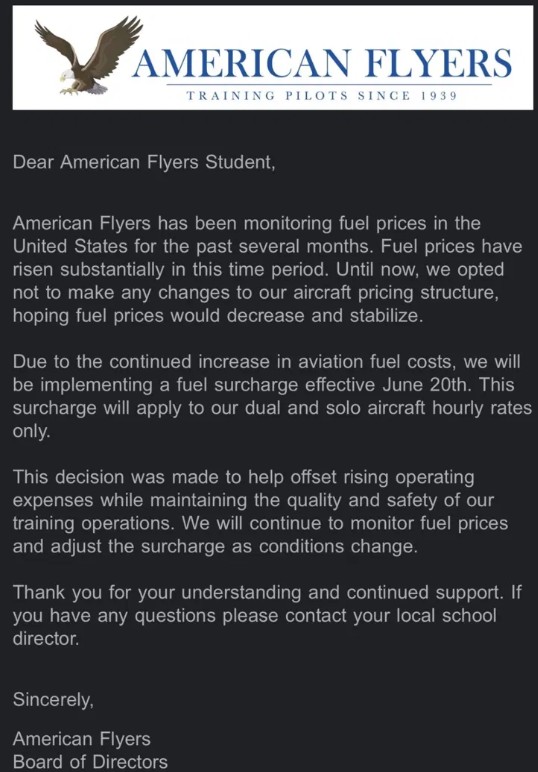
If you’re training with American Flyers, you got the email on June 13th, and the subject line didn’t mince words: a price increase for 2026. Effective June 20th, there’s a fuel surcharge landing on dual and solo aircraft hourly rates. The reasoning is the one we always get… rising aviation fuel costs, the need to offset operating expenses, a promise to “monitor and adjust as conditions change.”
I want to be fair here before I’m skeptical, because both can be true at once. So let’s actually look at what’s happening with fuel, and then let’s talk honestly about the part of that email I’d circle in red: the word adjust.
The fuel story is real… this part isn’t spin
Let’s give credit where it’s due. The fuel-cost pressure American Flyers is pointing at is genuine, and the numbers back them up.
Avgas, the 100LL that every piston trainer in their fleet burns, has been climbing all year. Back in January, the national full-service average sat around $6.37 a gallon, according to General Aviation News. As of today, GlobalAir’s national tracker has 100LL at roughly $7.47 a gallon. That’s about a 17% jump in under six months, and if you’re flying out of the Northeast or anywhere remote, you’re paying meaningfully more than that.
Why the spike? This isn’t a school padding its margins for fun. At the end of February, air strikes on Iran and the effective closure of the Strait of Hormuz set off what IATA describes as the single largest supply disruption in the history of the global oil market — roughly a quarter of the world’s crude moves through that one waterway. IATA now pegs average jet fuel for 2026 near $152 a barrel, close to 70% above the prior year. General Aviation News has tracked the knock-on climb into our piston world too.
So when the email says fuel got expensive, that’s not a story. That’s just Tuesday in 2026.
Here’s the part that should give us pause
Now the skeptical half, and this is where I want us all paying attention. The surcharge is being framed as responsive, it goes up when fuel goes up, and the school will “adjust” as conditions change. The quiet implication is that when fuel eventually settles, the surcharge eases off too.
I would not hold my breath. And I’m not guessing, we have decades of receipts on exactly how this plays out.
Fuel surcharges are one of the most reliably sticky prices in all of aviation. NerdWallet lays out the history bluntly: when airlines first invented fuel surcharges and oil later came back down, the surcharges simply didn’t come off. Wego puts it just as plainly for 2026 , the fee is supposed to fall when prices drop, but in practice it rarely does.
This isn’t ancient history, either. Go back to 2008, when NPR documented gas falling more than a dollar and a half a gallon while the surcharges customers were paying just… stayed. More recently, travel-management firm Advito found that even with jet fuel down about 15% year over year, carrier surcharges kept climbing, to the point where the fee no longer tracks the actual cost of fuel at all.
See the pattern? A surcharge is easy to introduce as “temporary.” It is extraordinarily hard to remove once it’s quietly become part of the baseline. The mechanism that justifies it on the way up develops a curious case of amnesia on the way down.
Now let’s talk about the number that should terrify us: zero to 1,500 hours

Here’s where this stops being an annoyance and starts being a wall. For those of us chasing the airlines, the finish line isn’t a single certificate — it’s the 1,500 flight hours the FAA requires before a regional will even look at our résumé. And that climb was punishing before anyone said the word “surcharge.” The structured zero-to-airline programs are already quoting six figures just for the certificates and ratings: ATP Flight School lists $123,995 starting from zero experience, Epic Flight Academy’s zero-to-airline program runs about $96,839 all-in, and US Aviation Academy lands in the mid-$90,000s. That’s a mortgage-sized bill before we’ve logged hour one toward the back half of 1,500. Now bolt a per-hour fuel surcharge onto every dual and solo hour in that front stretch, the exact hours American Flyers just targeted. Even a few dollars an hour, multiplied across the hundreds of metered hours it takes to earn a commercial certificate and instructor ratings, quietly piles thousands onto a tab that already reads like a down payment on a house. The six-figure road to the airlines just grew another floor, and per the pattern we just walked through, that floor isn’t sinking back down.
What this means for those of us actually trying to finish a rating
Let’s bring it home, because this is the part that matters to us. Flight training is already brutally expensive, and the costs that hurt most are the ones tied to the hour, the dual rate, the solo rate, the meter that runs every minute the prop is turning. A fuel surcharge bolted directly onto hourly rates hits the single most painful line item in the entire endeavor.
And here’s the compounding problem: training isn’t a fixed-price product. We don’t all finish a private certificate in the FAA-minimum 40 hour, the real-world average runs well beyond that. So a surcharge per hour doesn’t just nick us once. It multiplies across every hour of a checkride-bound journey that’s already longer and pricier than the brochure promised. Add a sticky surcharge that historically never retreats, and the honest forecast is that this is the new floor, not a temporary ceiling.
So where does that leave us?
I’ll be straight, because that’s the deal we have: I can’t prove American Flyers will never roll this back. The email genuinely leaves the door open, and I’d be thrilled to eat these words in a year. But “we’ll adjust as conditions change” is precisely the language the entire industry has used for twenty years to mean “this is staying.” The base rate of surcharges quietly becoming permanent is high enough that the smart money,our money, should plan as if it’s permanent.
So what do we actually do with that? A few practical moves. Lock in and budget at the new rate, not the old one. If your school offers self-service fuel or block-time discounts, ask about them — self-serve avgas alone tends to run around 15% cheaper than full service. Fly efficiently and brief hard on the ground so the expensive hours in the air count. And if you’re shopping schools, compare the all-in hourly rate with the surcharge baked in, because that’s the number that’s going to follow you to your checkride.
The flying is still worth it. It always is. But let’s go into 2026 with our eyes open and our wallets braced, because if history is any guide, this surcharge isn’t a storm passing through. It’s the new weather.